Stories that stick
with Dr. Chloe Sharp


I was recently invited to talk about storytelling for the Female Product Lead (FPL). It’s a topic close to my heart, and I was excited to talk about it.
A little about me. I’m the founder of Sharp Insight. We work with founders, leaders and accelerators to validate market need, prove impact, de-risk commercially and get startups and SMEs funding-ready.
In my career and in my everyday life at Sharp Insight, I use storytelling in multiple ways. From telling other people’s stories when I’ve done research, whether it be attitudinal, social, evaluation or user research, through to technical writing, and I’ve shaped narratives in grants, bids/tenders, reports, published papers and business cases. I’ve written “Make Products That Matter”, which follows the journey of Sam, a Lemonade Van owner, putting into practice the theory of customer-centric product development.
I enjoy making music and learning about songwriting. Songwriting has deep roots in storytelling and bringing the listener into a different world, one that they can almost feel, smell and touch. Related to songwriting is poetry. I recently learned about minimalist poetry, such as Haiku, stripping back words to only the most essential. This resonated with me as stories can be told with brevity and a small word count or timeframe, similar to grant applications and bid/tender writing styles.
Why storytelling matters
Storytelling is everywhere. Stories are all around us, from our thoughts and our culture, to the choices we make and the things we build.
Storytelling has fascinated me for a long time. I was lucky enough to travel in my 20s, and I found it fascinating how stories were told in some of the oldest cultures and were still alive today. For example, Aboriginal stories in Australia, particularly the Dreamtime. These ancient tales are passed down from generation to generation, explaining creation, the formation of land and how to live ethically.
When I studied for my PhD, an element of this was sociology, and that’s where I learned about social constructionism. Social constructionism argues that what we perceive as ‘real’ is a product of our social interactions and the language we use to describe them. Storytelling and social constructionism are intertwined because the stories we tell are a way that we construct shared realities, understanding our identities and make sense of the world around us.
Everything has a story if you search for its origin. These stories shape our everyday lives, milestone events and the way we organize our lives. When you ask, “Why is something done this way?” - you’ll find a story.
If you have read Yuval Noah Harari’s book Sapiens, you will remember the idea that Homosapiens rose to the top because we can share stories that let strangers cooperate. Yuval Noha Harari says:
“Storytelling is our superpower. We are the only species with the ability to use language - not just to describe things we can see, taste, and touch, but also to invent stories about things that don’t exist.”
“Stories are the greatest human invention. People need stories in order to cooperate. But there’s also something else very important: they can change the way they cooperate by changing the stories they believe.”
We tell a story, we believe it together, and then we act in ways that make the story true.
Product leadership works the same way. You set a direction, you explain who it serves, you choose trade-offs, and then hundreds of small actions align because people share the same narrative. When your story travels, your roadmap moves. When your story is fuzzy, the work scatters.
In this article, I will give you simple tools to make your story stick. You will be able to win attention, reduce ambiguity, and get decisions made, even when the room is busy. Everything here is designed for women in product who are balancing influence with delivery.
Core storytelling frameworks for product leaders
Storytelling is useful for product leaders, particularly at a time when pressure is on for product teams to drive profit and demonstrate business value and results. Storytelling can drive action, create alignment and build empathy.
There are a number of storytelling frameworks that product leaders can use.
The storytelling arc
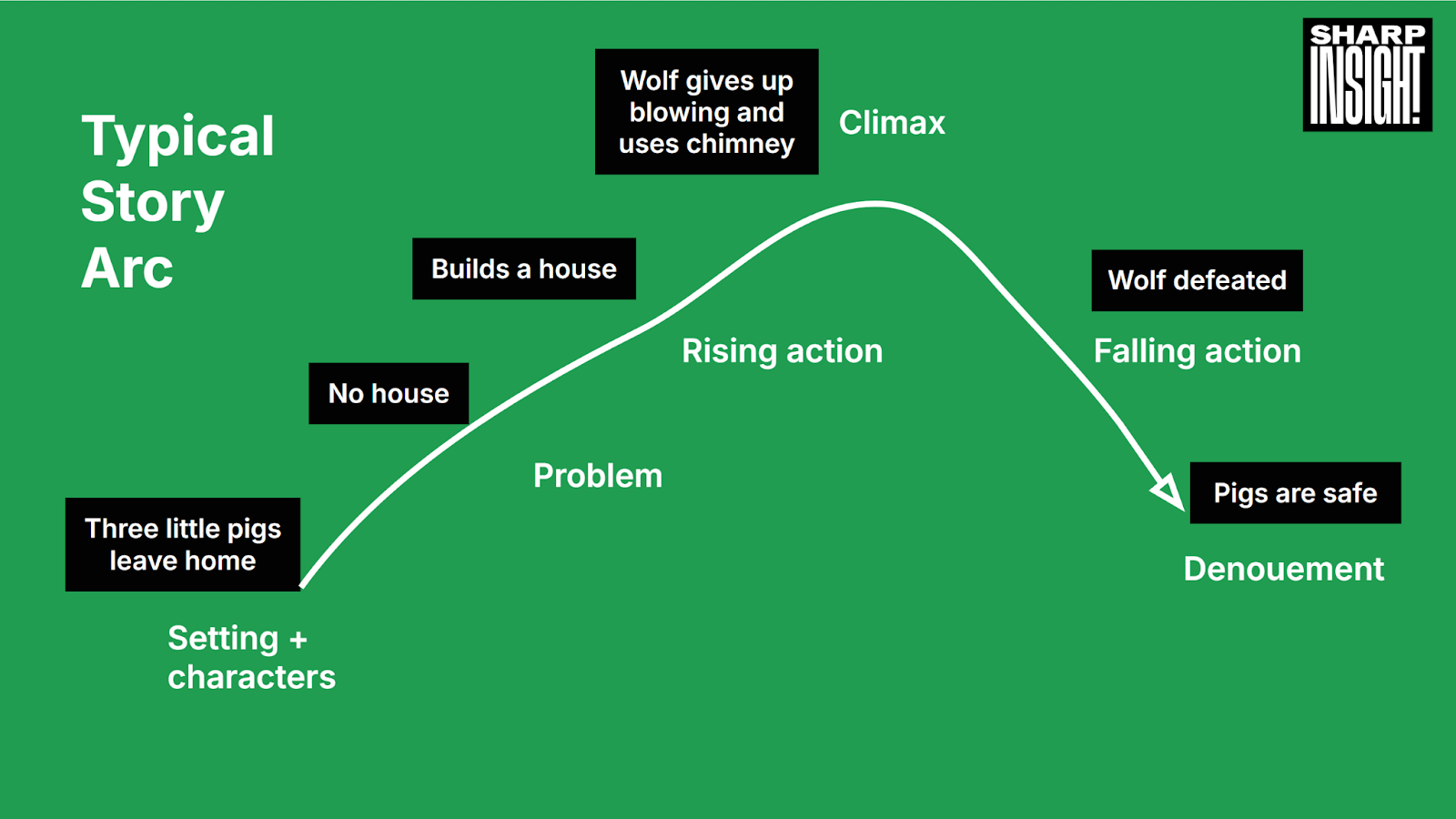
I’ve overlaid the story of Three Little Pigs to demonstrate the framework. This shows that it’s good to balance each part of the story and not to focus too much on one aspect. Sometimes in stories, lots of time can be spent on one aspect such as the problem and too little on the setting and characters. This arc is great approach for including each part of the story and working out which aspects need more or less emphasis.
The Three-Act Structure
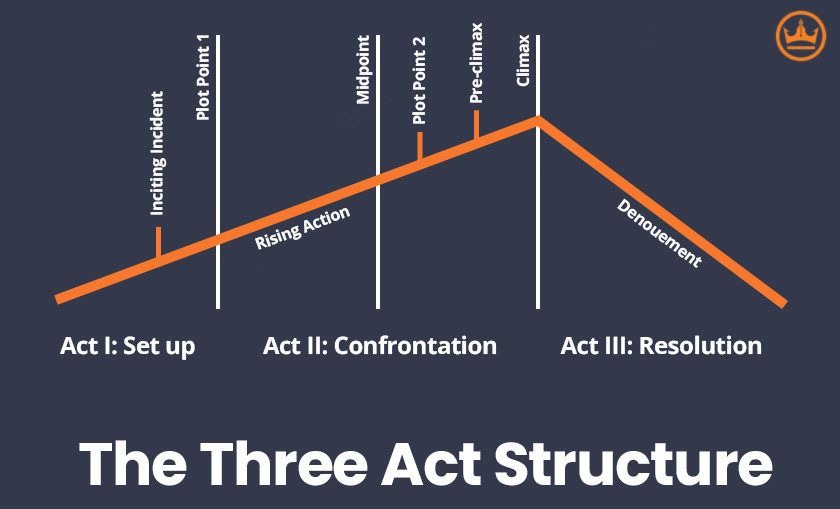
Source: Kindlepreneur
Next, we have the Three-Act Structure. This expands on the typical story arc by tracking the path of change over a period of time. It tracks how a character, audience or idea transforms either over a sustained period, like a book or a film, or through an entire series.
In a product management scenario, if we were to zoom out, the Three Act Structure could show the product development journey, from Discovery to Planning to Execution phases. It is a framework that can be used for product pitches to show the need for a feature or product, presentations and reports where data is transformed into a story that inspires
For example, in my book “Making Products that Matter”, Act I, the “set up” sees Sam, our Lemonade Van entrepreneur, develop the initial idea of running a lemonade van from her memory of a childhood lemonade stand. It builds out the world, her goal and commits her to a path: defining her customer personas and exploring jobs to be done by the lemonade.
Act II, “Confrontation”, is our rising action. Sam faces obstacles she must overcome, competitors analysis and market assumptions. A SWOT analysis and some mapping exercises later and this phase finds its climax in the customer research and testing prototypes, which viably tests her solution.
Act II, “the Resolution”, moves us towards conclusion, with Sam deep in the analysis of her customer feedback, refining her business model and value proposition canvases. The ultimate resolution, a customer-centric product validated through a closed beta test, ready for market.
The larger story arc flows through all three acts, each containing its own arc, in fact we’ve got customer story arcs and team operation story arcs running in parallel. The arcs are there to keep the human change front and centre, helping you maintain focus on the most important objectives.
This Three Arc Structure can find its way into meetings, business cases and slide decks. As humans, we’ve been hearing this methodology since we were young and so it feels familiar.
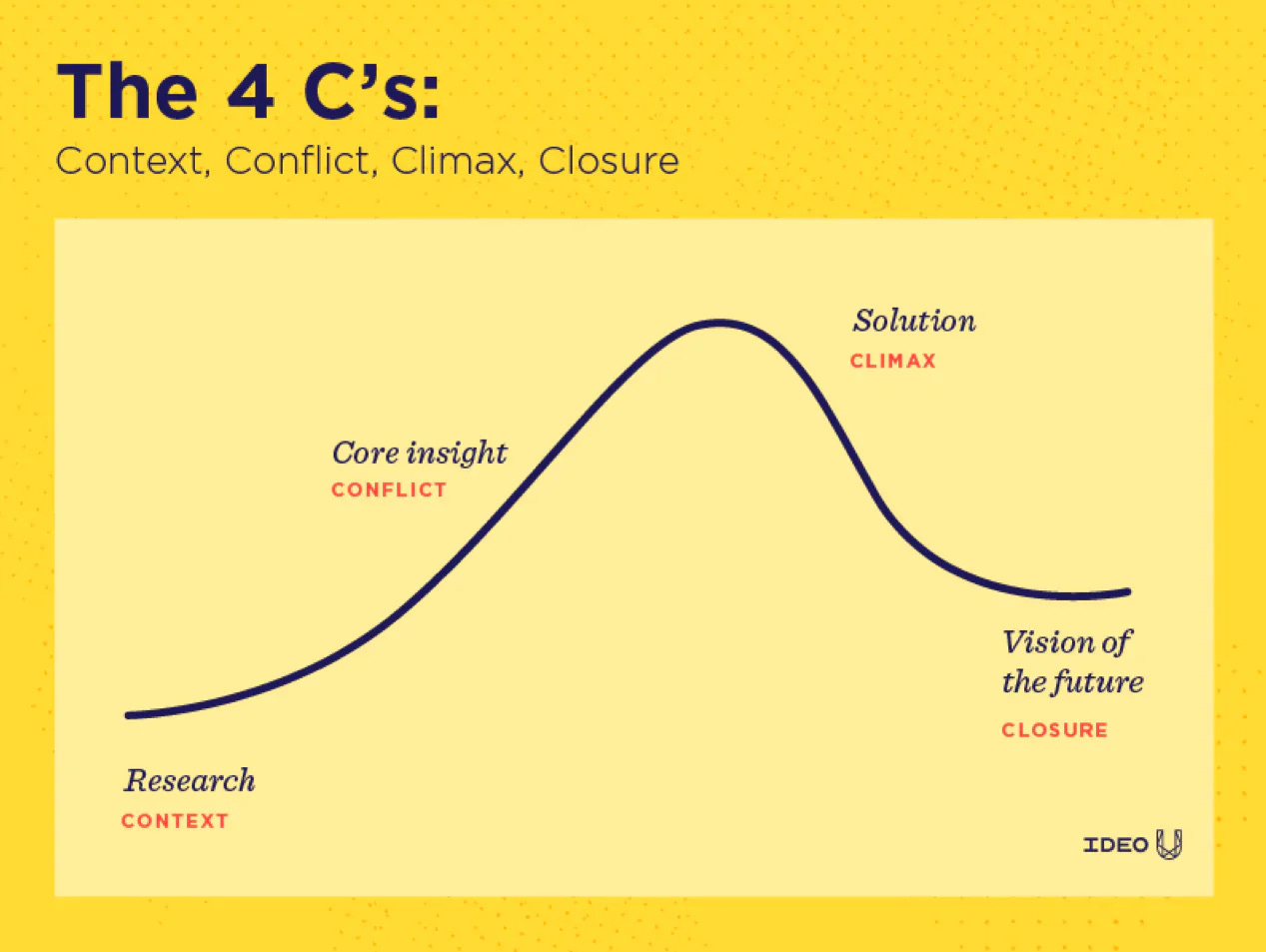
Source: IDEO U
IDEO has storytelling resources, and a course on storytelling. They outline the 4Cs.
Here, the context is the user, the conflict is the user’s pain point/problem, the climax is the solution for the use case to solve the pain point and closure ends the product’s value for the future of the user.
Focused storytelling frameworks for persuading and influencing
The Hero’s Journey for persuasion and buy-in for big visions.

Source: Wikipedia

This is how you may use it to pitch a vision. In this example below, this shows how to use the Hero’s Journey to pitch the use of AI in an existing product.
Ordinary world. Start with how your current product is used today and where users stall. For example, the time to the first completed task is two days, adoption dips after week two, and there are 32 setup tickets per 100 accounts. Keep it human so leaders can feel the friction, so it’s not all about the stats and technical detail.
Call to adventure. Name the signal you’ve identified in the data and by customers, and why it matters now. Customers are asking for guidance rather than more buttons, and internal data shows drop-offs in complex setups.
Obstacles. Lay out the constraints and the cost of delay. Privacy and data governance, evaluation design, model cost and latency, hallucination risk, thin platform capacity, and brand concerns. If you delay, you risk churn in your highest value cohorts and a feature race you cannot win.
Breakthrough. Show the action that proves the AI vision on a small scale. Choose one journey, one prototype, or one metric. For example, a Wizard of Oz (this is where the back end is delivered by a person and not the tech, as it’s not been built yet) onboarding assistant for finance admins that suggests next best actions inside the workflow. Define a north star of time to first value, a safety metric for error rates, and a two-sprint plan with a named owner.
Return transformed. Share the early result you expect to see and the lesson the organisation can reuse. For example, you may expect to see time to first task down by 30 per cent in the user flow, support tickets down by 20 per cent, and sales using the demo with confidence. The lesson is to guide users inside the work, one journey at a time. End with a single ask, an owner, and a clear pilot timeline.
Short, but effective frameworks: PAS and ABT.
PAS: Problem-Agitate-Solution is good for pitching, perhaps new initiatives, a resource ask, a change of priority, or a decision that needs executive attention. Here is the same scenario we had for the Hero’s Journey using the PAS framework.
Problem. New customers take two days to complete their first task, adoption dips after week two, and there are 32 setup tickets for every 100 accounts, which tells us users need guidance inside the workflow.
Agitate. If we do nothing, high-value cohorts will churn as competitors market assistants, support costs will rise this quarter, and sales cycles will lengthen as buyers question ease of use. We also risk a feature race that absorbs capacity without moving time to value.
Solve. Run a two-sprint Wizard of Oz pilot for the target users that suggests next best actions in product. Success is a 30 per cent improvement in time to first task and a 20 per cent drop in setup tickets in the pilot cohort, with a safety metric on error rates.
Ask (although not part of the framework, is useful for pitches): Approve a pilot with one product lead, one designer, and three engineers, with fortnightly reviews and a phase two decision at day 90.
And But Therefore with But Therefore used by South Park to avoid using ‘and then’ to stop waffling and be succinct.
And. New customers arrive ready to work, and onboarding spans several steps across settings and integrations. The time to first complete the task is two days, and there are 32 setup tickets for every 100 accounts.
But. Adoption dips after week two, customers are asking for guidance rather than more buttons. If we delay, we risk churn in high-value cohorts and rising support costs this quarter.
Therefore. A two-sprint Wizard of Oz pilot for onboarding suggests next best actions inside the product. Success is a 30 per cent improvement in time to first task and a 20 per cent drop in setup tickets in the pilot cohort, with a safety metric on error rates.
Ask (not part of the framework but good for pitches): Approve a pilot with one product lead, one designer, and three engineers, with fortnightly reviews and a phase two decision at day 90.
When pitching, adapt to your audience as much as you can, and when planning, anticipate the questions. Using the example we’ve used so far, here are a few questions to anticipate and how they may be answered, so we know how to respond:
Why are you showing me this? Because data inconsistency is slowing revenue decisions and damaging trust with buyers. This is the simplest path to restore confidence and speed.
What do you need from me? Approval for a pilot, the named team members, budget sign-off, and agreement on the three events that matter most.
How will we know if it works? Decision latency shortens, the weekly funnel matches finance within tolerance, data incident time to resolution drops by half, and product reviews stop debating the numbers.
Practicing your story and how you tell it
We’ve gone through storytelling frameworks; now you can try to use these to create your own story. Try this storytelling workbook to help you plan and structure your story. Also consider how you’ll tell your story.
STAR: Something They’ll Always Remember.
Start by putting your audience first. If you’re talking to leaders, what matters to them this quarter? How does this fit in and help them with their goals? What words do they use to describe success and risk? Borrow those words so the story lands.
Take them on a short emotional journey. Begin with a feeling they recognize, a little friction or hope, then show a turn that changes the outlook. A touch of humour can warm the room and lower the guard, but keep it kind and light. Hold yourself to one idea. When you chase two ideas, neither sticks. Use a personal story or a vivid analogy to give the idea quickly. A quote from a customer, a short dramatization of a painful workflow, or a simple comparison can make the abstract concrete.
Keep your story simple: One idea. One feeling. One ask.
This can apply to meetings and talks, and in your documents too. Open a pre-read with a short story instead of a table of contents. Add a callout box with the customer quote that shaped the decision. In a report, write a two-sentence vignette before the chart so the chart has a purpose. When you treat every artefact as a chance to create a S.T.A.R. moment, people remember, they repeat, and they move with you. IDEO:U have an interesting article on how to present stories here.
Key takeaways
To summarise:
Practice using storytelling techniques and assess if you’re getting the outcomes you’re hoping for
Bringing the audience into the journey, involving stakeholders as much as you can rather than telling
Help your colleagues use storytelling techniques so it becomes the norm
Adapt your storytelling style to the situation and audience
Get feedback on your storytelling approach
About the author
Dr Chloe Sharp is an experienced product leader, researcher, and storyteller with over 15 years’ experience helping organisations turn ideas into products that matter. As the author of Make Products That Matter, she combines deep expertise in product management, user research, and leadership with a unique ability to craft stories that win stakeholder buy-in and inspire action. Chloe has advised startups, scale-ups, and global brands, guiding teams to make evidence-based decisions, align around shared visions, and successfully bring innovative products, including AI-driven solutions, to market.
You can connect with Chloe on LinkedIn and book time to speak with her here for a 30-minute free storytelling clinic to review a report or pitch that isn’t landing, a customer insight sprint or leadership coaching. She is also the author of the book “Make Products That Matter”.
 | A guest post by
|